The Century in Mirror: Why does 2026 look so much like the imminence of 1926?
A century apart, 1926 and 2026 reveal how tech optimism can hide fragile peace, institutional fatigue, and rising geopolitical tension.

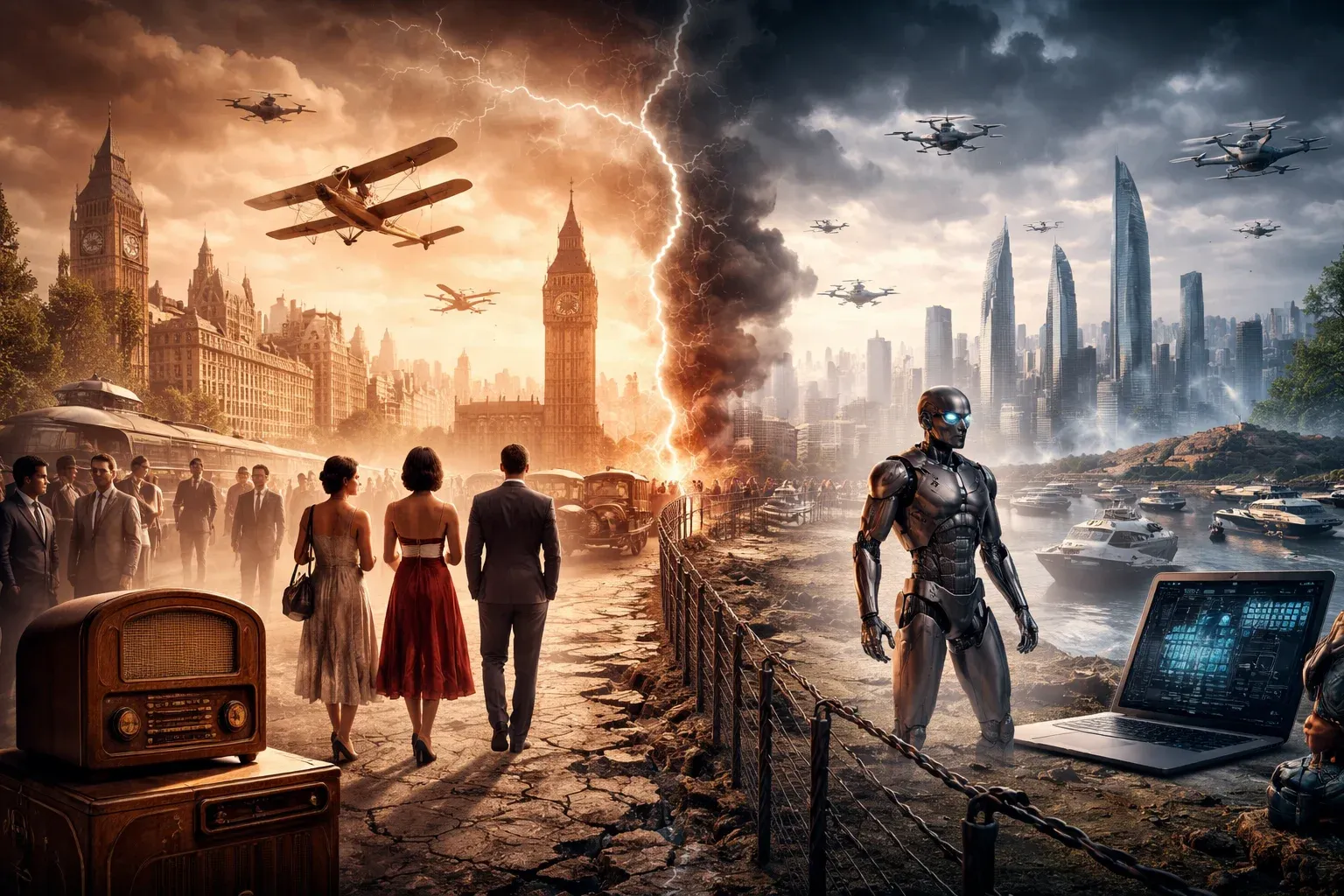
2026 vs. 1926: Are We Repeating the Mistakes That Led to World War II?
There is a strange feeling in the air in 2026 — a geopolitical déjà vu that is difficult to name but impossible to ignore. We are living through a technological revolution that is reshaping how we think, work, and communicate. And at the exact same time, borders are hardening, alliances are cracking, and trust between nations is quietly draining away.
Sound familiar? It should.
Because a century ago, the world felt almost identical. And we know how that story ended.
What Was Really Happening in 1926 — Beneath the Optimism
In 1926, hope was fashionable.
The Treaty of Locarno had just been signed. Germany had entered the League of Nations. Newspapers were celebrating peace as if it were a permanent achievement rather than a fragile, living process.
But underneath all of that optimism, something far more dangerous was quietly building.
Society was transforming at a speed that felt disorienting. Rural populations were flooding into cities. Factories were redefining what work meant. The assembly line changed the rhythm of daily life. And the radio — this magical, electric new device — created the first form of mass global communication. For the first time in history, millions of people could receive the exact same message, at the exact same moment.
This was the direct ancestor of today's social media algorithm.
And yet, policymakers made a catastrophic mistake: they ignored economic resentment. War reparations, unemployment, inflation, and national humiliation were simmering just below the surface. Those emotions would later become the fuel for authoritarian leaders who promised dignity through domination.
The world in 1926 did not fail because it lacked intelligence. It failed because it underestimated how explosive collective frustration can become when left unaddressed.
How 2026 Rhymes With 1926 — With Unsettling Precision
In 1926, the defining technologies were the assembly line and the combustion engine. In 2026, they are Generative AI and autonomous systems. Both moments share the same psychological fingerprint: automation reshaping labor, and that reshaping generating fear.
Fear creates demand for certainty.
Certainty creates demand for strong leaders.
Strong leaders test the limits of institutions.
A century ago, the League of Nations slowly lost authority as nations stopped respecting its rulings. Today, we see growing paralysis in the United Nations and mounting internal tensions within alliances like NATO. When the rules of the game are no longer enforced, the game itself becomes unstable.
Meanwhile, globalization is showing the same fractures it did in the 1920s. Back then, protectionism returned with force. In 2026, supply chains fragment, trade wars intensify, and nations race toward "strategic autonomy" — code for going it alone.
History does not repeat itself exactly. But it rhymes with precision that should make you uncomfortable.
The agentic shift in AI is accelerating this dynamic in ways we are only beginning to understand. When intelligent systems can replace entire categories of skilled work, the social contract of previous generations collapses. And collapsed social contracts are historically where authoritarian narratives find their audience.
The Psychology That Makes Us Miss the Warning Signs
Here is the uncomfortable part — this is not about ignorance. It is about selective attention.
The average citizen in 1926 read about distant geopolitical tensions in the newspaper between stories about cinema, fashion, and the urban excitement of modern life. Conflict felt far away, theoretical, almost abstract.
The same psychology operates today.
You scroll past headlines about territorial disputes and failing trade negotiations — right between a product launch video and a wellness reel. We are obsessed with optimization, aesthetics, and personal performance while tectonic geopolitical plates quietly shift beneath us.
Philosophers once called this the "sleep of reason." The moment when comfort and distraction dull our perception of real risk.
Research published in Nature Human Behaviour (2022) found that individuals consistently underestimate the probability of systemic risks when they are surrounded by signals of personal progress and economic stability — precisely the condition that dominated both the late 1920s and our current moment.
This is not a character flaw. It is a cognitive architecture problem. Our brains are wired to prioritize immediate, concrete threats over diffuse, systemic ones. Understanding this bias is the first step toward overcoming it.
My Take on This — As Someone Who Studies These Cycles
I want to be honest with you about something personal here.
I have spent years studying masculine psychology, civilizational cycles, and the patterns that underlie both individual and collective decline. What I keep returning to is this: the crises that destroy individuals and nations are almost never the ones people saw coming. They are the ones that people felt vaguely uneasy about — and then looked away from.
When I read about the institutional fatigue happening right now in global governance, I do not feel panic. I feel the specific discomfort of recognizing a pattern. The same pattern I explore when writing about what happens to men when they lose direction in modern society — because the dynamics are structurally similar. The withdrawal of engagement. The preference for comfort over confrontation. The slow erosion of the structures that kept things stable.
The lesson is not that catastrophe is inevitable. The lesson is that it becomes inevitable only when enough people decide that engagement is someone else's responsibility.
The Economic Anxiety Nobody Wants to Talk About
One of the clearest parallels between 1926 and 2026 is economic anxiety driving political instability.
In the 1920s, the reparations imposed on Germany by the Treaty of Versailles created a slow-burning economic humiliation that reshaped European politics from the ground up. The inflation. The unemployment. The sense that the system was rigged against ordinary people.
Today, you do not have to look hard for equivalent pressures.
AI-driven displacement of white-collar work. Real wage stagnation in developed economies. Housing costs that have decoupled from income in nearly every major city. The perception — often accurate — that the existing system serves people who are already inside it.
I wrote about the mechanisms of the next monetary crisis in more detail elsewhere, but the core point is this: economic humiliation does not stay economic. It becomes political. And it becomes personal.
When people feel that honest work no longer leads to a dignified life, they become receptive to narratives that promise to restore that dignity through power rather than reform.
This is not a theoretical concern. It is a documented historical mechanism that has played out across cultures and centuries.
What the League of Nations Can Teach Us About the UN Today
The League of Nations was not a bad idea. It was a good idea that was never given the conditions it needed to succeed.
Member states retained the right to ignore inconvenient rulings. Major powers — including the United States — refused to join or later withdrew. The institution was designed for cooperation but was populated by governments that prioritized sovereignty above every other consideration.
Sound familiar?
Today's United Nations faces structurally identical tensions. Veto power paralyzes the Security Council on the decisions that matter most. Regional blocs fracture over trade, climate, and military alignment. The gap between what multilateral institutions are supposed to do and what they can actually enforce grows wider every year.
This is not a reason for cynicism. It is a reason for urgency.
If you want to understand why civilizational reset moments are so dangerous — not because destruction is inevitable but because the window for course correction is always narrower than it appears — read what I wrote about the last reset. The dynamics translate directly.
Technology Accelerates Everything — Including Instability
In the 1920s, radio was the first mass communication tool. It created the possibility of reaching millions simultaneously with a single message. It was also the medium through which fascist and nationalist movements would later spread their narratives with devastating efficiency.
In 2026, we have something orders of magnitude more powerful: AI-generated content, social platform algorithms optimized for engagement over accuracy, and deepfake technology that makes it increasingly difficult to distinguish authentic information from manufactured reality.
The 1920s showed us that a new communication technology does not automatically democratize truth. It democratizes reach. And reach, in the hands of actors with bad intentions and strong narratives, is a weapon.
This does not mean technology is the enemy. It means technology is neutral — and neutrality always serves whoever uses it most skillfully.
Peace Is Not an Achievement. It Is a Practice.
This is what 1926 got catastrophically wrong.
The generation that rebuilt after World War I made the understandable mistake of treating peace as a destination rather than a discipline. They believed that the sheer horror of what they had lived through would serve as a permanent deterrent. That no rational government would ever risk repeating it.
They were wrong. Not because humans are evil, but because institutional memory is short, economic pressure is constant, and demagogy is always available to anyone willing to use it.
Peace is the presence of constant dialogue, constant maintenance, constant humility. It requires effort precisely in the moments when everything seems stable — because that is exactly when the structural vulnerabilities are being ignored.
The real question in 2026 is not whether we are living through a technological revolution. We clearly are. The real question is whether we are also evolving in our capacity to live together without recreating the mistakes of a century ago.
That is a question only action can answer.
Conclusion: The Window Is Open — For Now
I am not writing this to generate fear. I am writing it because pattern recognition is one of the most valuable skills any person — or any civilization — can develop.
The parallels between 1926 and 2026 are real, documented, and significant. But parallels are not destiny. History rhymes; it does not have to repeat.
The difference between a rhyme and a repetition is what people do in the space between the warning and the outcome.
If this kind of long-form thinking about civilizational cycles, masculine identity, and the structures that shape human behavior interests you, explore the rest of what I am building on this blog. There is more where this came from.
FAQ — 2026 vs. 1926: Your Questions Answered
1. Is the comparison between 1926 and 2026 historically accurate, or is it just a metaphor?
It is both. Historians have noted structural parallels between the interwar period and the current moment — including the erosion of multilateral institutions, the return of economic nationalism, and the destabilizing effects of rapid technological change. The comparison is not meant to predict a third world war but to identify patterns of institutional decay that historically precede major conflicts. The purpose is analytical, not alarmist.
2. What is the biggest difference between 1926 and 2026 that could prevent history from repeating?
The most significant difference is the existence of nuclear deterrence among major powers, which creates a structural barrier to total war between great powers that did not exist in 1926. Additionally, global economic interdependence is far deeper today — which creates incentives for de-escalation that were absent in the interwar period. These are not guarantees, but they are meaningful structural differences.
3. How does Generative AI specifically amplify geopolitical instability?
AI enables the mass production of targeted disinformation, deepfakes, and synthetic narratives at a scale and speed no previous technology could match. It also accelerates labor displacement, which historically correlates with political radicalization. Beyond that, the competition for AI supremacy between major powers — particularly the US and China — is itself a significant source of geopolitical tension.
4. Why do people fail to notice geopolitical risks until they become crises?
This is a documented cognitive phenomenon. Research on "finite pool of worry" and attentional bandwidth shows that when people are managing high volumes of personal information (which modern media environments guarantee), systemic and diffuse risks are consistently deprioritized in favor of immediate, personal concerns. This is not irrationality — it is a feature of how attention works. Understanding the bias is the first step to partially correcting it.
5. What can an ordinary person actually do about geopolitical instability?
More than most people think. At the individual level: stay genuinely informed rather than just algorithmically entertained; support institutions and leaders who prioritize multilateral engagement; be willing to discuss these issues seriously rather than retreating into tribalism. At the community level: invest in the social fabric — local institutions, civic participation, honest dialogue across political divides. Geopolitical stability is not built only in capitals. It is built, or eroded, in the aggregate choices of millions of ordinary people.


