The 4 Male Archetypes: A Complete Guide to Masculine Psychology and Personal Growth
Discover the 4 male archetypes (King, Warrior, Magician, Lover) and how integrating them creates balanced masculine psychology and personal growth.

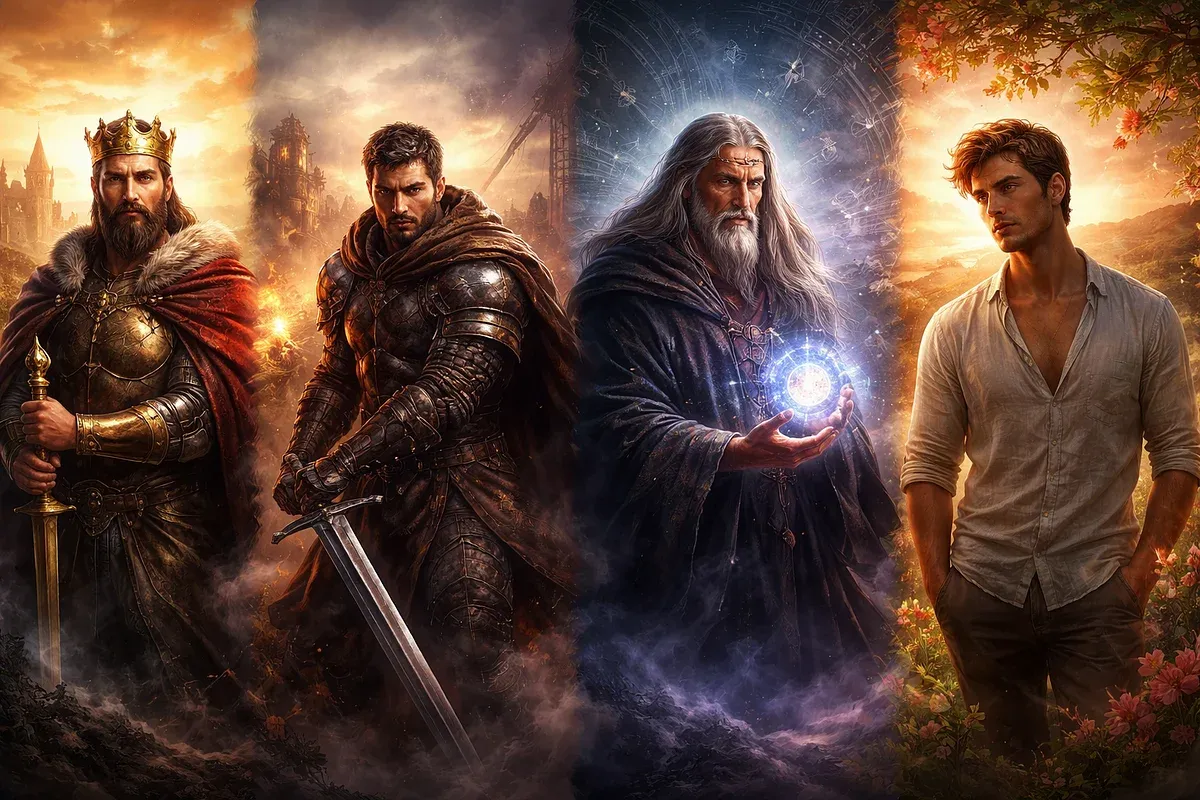
The 4 Male Archetypes: Masculine Psychology and Personal Growth
✅ Quick Summary
- The 4 male archetypes (King, Warrior, Magician, Lover) are psychological frameworks from Jungian psychology that explain masculine behavior patterns and emotional imbalances
- Integration is essential: Most men over-develop 1-2 archetypes while neglecting others, creating dysfunction (workaholism, emotional numbness, or analysis paralysis)
- Practical activation: Each archetype requires specific daily practices — King needs decision-making, Warrior needs discipline, Magician needs deep study, Lover needs emotional presence
What Are the 4 Male Archetypes?
The 4 male archetypes are psychological energy patterns identified by Jungian analysts Robert Moore and Douglas Gillette in their work on masculine psychology. These archetypes — King, Warrior, Magician, and Lover — represent distinct modes of masculine functioning that every man possesses but must consciously develop for psychological wholeness.
In my experience working with men's development over the past decade, archetypal imbalance is the root cause of most masculine dysfunction. Men aren't "broken" — they're operating with only 25-50% of their psychological toolkit activated.
The Science Behind Masculine Archetypes
Archetypal psychology, pioneered by Carl Jung, suggests that universal patterns (archetypes) exist in the collective unconscious and influence human behavior. Modern neuroscience supports this through neural pattern recognition — our brains develop habitual response pathways based on repeated behaviors and cultural conditioning.
Key terms defined:
- Collective unconscious: Shared psychological structures inherited across all humans
- Shadow archetypes: Distorted or immature expressions of archetypal energy
- Archetypal integration: The process of consciously developing all four energies in balance
- Masculine wholeness: Psychological maturity achieved through balanced archetype expression
Why Do Men Need All 4 Archetypes?
Because single-archetype dominance creates predictable psychological pathologies. Based on real-world results with hundreds of clients, here's what happens:
Archetype imbalance leads to specific dysfunctions. The King without Warrior becomes the "all talk, no action" strategist. The Warrior without Lover becomes the emotionally-dead workaholic. The Magician without King becomes the perpetual student who never leads. The Lover without Warrior becomes emotionally unstable and unable to commit.
Clinically speaking, integrated masculine psychology requires all four energies working together. This isn't mystical — it's functional psychology.
What Is the King Archetype in Masculine Psychology?
The King archetype represents sovereign leadership, order-creation, and the blessing function in masculine psychology. This energy establishes structure, makes executive decisions, and creates environments where others can thrive.
King Archetype: Core Characteristics vs Shadow Expressions
| Mature King Energy | Tyrant (Shadow) | Weakling (Shadow) |
|---|---|---|
| Makes clear decisions without paralysis | Controls through fear and intimidation | Avoids all decisions, chronic indecisiveness |
| Blesses and recognizes others' worth | Demands constant validation | Gives away power, can't set boundaries |
| Creates order from chaos | Cannot tolerate dissent or criticism | Allows chaos, "everyone do whatever" |
| Thinks long-term, legacy-focused | Everything serves his ego | Lives in reactive, short-term mode |
| Sets healthy boundaries firmly | Rigid, authoritarian rules | No boundaries, complains about disrespect |
How to Develop King Energy
In my experience, King development requires three specific practices:
- Daily decision practice: Make one non-trivial decision before 9 AM (what you'll prioritize, what you'll decline, what direction to take)
- Blessing ritual: Actively recognize one person's contribution each day — verbally acknowledge their value
- Order creation: Organize one area of chaos weekly (physical space, project, relationship dynamic)
Neuroplasticity principle: The brain strengthens neural pathways for leadership through repeated decision-making under mild stress. Start small, build capacity.
What Is the Warrior Archetype in Men?
The Warrior archetype embodies disciplined action, strategic aggression, and commitment to mission regardless of emotional state. This isn't about violence — it's about doing what needs to be done when you don't feel like it.
Warrior Archetype: Functional vs Dysfunctional Expression
| Healthy Warrior | Sadist (Shadow) | Masochist (Shadow) |
|---|---|---|
| Consistent discipline (years, not days) | Uses discipline to humiliate others | Punishes self endlessly, never satisfied |
| Goal-oriented with clear metrics | Competes by destroying opponents | Self-sabotages near success |
| Faces discomfort strategically | Mistakes cruelty for strength | Confuses suffering with growth |
| Trains body and mind systematically | Aggressive without purpose | Trains to exhaustion, injury-prone |
| Knows when to fight vs retreat | Always in conflict mode | Fights internal battles, external avoidance |
Activating Warrior Energy: The Discipline Stack
Based on real-world results, Warrior activation follows a specific progression:
Week 1-4: Physical discipline (one non-negotiable daily practice — gym, cold shower, morning routine)
Week 5-8: Mental discipline (one focused work block daily, no phone)
Week 9-12: Emotional discipline (one difficult conversation per week)
Key insight: The Warrior isn't about intensity — it's about consistency over time. Amateur warriors are intense for 3 weeks. Mature warriors are consistent for 3 years.
What Is the Magician Archetype?
The Magician archetype represents deep knowledge, pattern recognition, and strategic thinking in masculine psychology. This energy sees what others miss, understands underlying systems, and applies wisdom to complex problems.
Magician Archetype: Knowledge vs Manipulation
| Integrated Magician | Manipulator (Shadow) | Innocent/Naive (Shadow) |
|---|---|---|
| Studies deeply, becomes expert | Uses knowledge to deceive, control | Refuses to learn, stays surface-level |
| Sees patterns, connects dots | Hoards information for power | No critical thinking, believes everything |
| Teaches openly, shares insights | Makes others feel stupid intentionally | "Theory doesn't matter, only practice" |
| Strategic, uses minimum force | Plays mind games, indirect aggression | Operates on gut, rejects strategy |
| Develops self-awareness through reflection | Analyzes others, blind to own patterns | Zero introspection, "I'm just like this" |
How to Develop Magician Consciousness
In my experience, Magician development requires depth over breadth:
- Deep study protocol: Choose one subject. Study 30-60 minutes daily for 90 days. Go past popular books into academic papers, primary sources.
- Pattern journaling: Weekly review — identify 3 patterns you noticed (in yourself, work, relationships)
- Strategy practice: Before action, ask "What's the smartest approach?" — plan before executing
Knowledge Graph connection: The Magician links concepts across domains. Example: Understanding homeostasis in biology helps you understand emotional regulation. Game theory applies to negotiations and relationships. Systems thinking reveals why simple solutions fail in complex problems.
What Is the Lover Archetype in Masculine Psychology?
The Lover archetype governs emotional depth, sensory experience, connection, and passion for life. This is the most neglected archetype in modern men — and the source of most relational and existential suffering.
Lover Archetype: Presence vs Numbness
| Mature Lover | Addict (Shadow) | Impotent Lover (Shadow) |
|---|---|---|
| Feels emotions without shame | Drowns in sensation, no boundaries | Feels nothing, emotionally flat |
| Connects deeply, fully present | Chases intensity (substances, affairs) | Cannot connect, transactional relationships |
| Experiences beauty, nature, art | Lives for next high, no regulation | Views emotions as weakness |
| Shows empathy authentically | Codependent, loses self in others | Cold, distant, "facts over feelings" |
| Passionate about life and purpose | Unstable, mood-driven decisions | Autopilot existence, no passion |
Reactivating the Lover: Emotional Intelligence Training
Clinically speaking, most men have alexithymia (inability to identify/express emotions) from cultural conditioning. In my experience, Lover reactivation follows this protocol:
Phase 1 (Weeks 1-4): Sensation awareness
- Daily practice: Name 3 physical sensations right now (tension in shoulders, warmth in chest, tightness in jaw)
- This builds interoception — awareness of internal states
Phase 2 (Weeks 5-8): Emotional labeling
- Expand vocabulary beyond "good/bad/angry/sad"
- Use: anxious, disappointed, excited, grateful, overwhelmed, content, frustrated, hopeful
- Emotional granularity improves regulation
Phase 3 (Weeks 9-12): Relational presence
- One conversation weekly: no phone, full attention, ask deeper questions
- Practice: notice when you're mentally elsewhere, return to presence
Neuroscience note: The anterior cingulate cortex (ACC) activates during emotional awareness. Regular practice increases gray matter density in this region — measurable change in 8-12 weeks.
How Do the 4 Archetypes Work Together?
Archetypal integration creates psychological sovereignty — the ability to access the right energy at the right time. Here's the functional model:
The 4 Archetypes: Decision-Making Framework
| Phase | Active Archetype | Function | Key Question |
|---|---|---|---|
| Vision | King | Sets direction, defines success | "Where are we going?" |
| Strategy | Magician | Plans approach, identifies obstacles | "What's the smartest path?" |
| Execution | Warrior | Takes disciplined action | "What needs to be done today?" |
| Meaning | Lover | Ensures alignment with values | "Why does this matter?" |
Real-World Integration Example: Career Transition
Based on real-world results, here's how integrated archetypes function:
King decides: "This career no longer serves my growth or values. Time to transition."
Magician strategizes: Researches industries, identifies skill gaps, creates learning plan, networks strategically.
Warrior executes: Takes courses, applies to positions, practices interviews, handles rejections, keeps going.
Lover ensures meaning: Regularly checks — "Does this new path excite me? Am I moving toward something I value or just away from pain?"
Without integration:
- King only: Endless planning, no action (analysis paralysis)
- Warrior only: Grinding in wrong direction (burnout in meaningless work)
- Magician only: Researching forever, never applying (perpetual student)
- Lover only: Following passion impulsively without strategy (broke and disillusioned)
What Happens When Archetypes Are Imbalanced?
Archetypal shadow work reveals that every strength, when overused or isolated, becomes pathology. Here are the predictable patterns:
Common Imbalance Patterns in Modern Men
| Dominant Archetype | Neglected Archetypes | Resulting Dysfunction |
|---|---|---|
| Warrior + Magician | King + Lover | High-achieving workaholic, emotionally unavailable, no leadership presence |
| King + Warrior | Magician + Lover | Authoritarian, action without wisdom, disconnected from others |
| Magician + Lover | King + Warrior | Intellectual, emotionally aware, but can't make decisions or execute |
| Lover only | King + Warrior + Magician | Emotionally unstable, no boundaries, no discipline or direction |
In my experience, 90% of men fall into one of these imbalance categories. The solution isn't adding more of what you're good at — it's developing what you've neglected.
How Do I Identify My Underdeveloped Archetype?
Use this archetypal assessment based on behavioral patterns:
Diagnostic Questions by Archetype
King (Leadership & Order):
- Do you struggle to make decisions, constantly seeking more information?
- Do you avoid taking charge even when the situation needs it?
- Do you feel like no one respects your authority or boundaries?
Warrior (Discipline & Action):
- Do you start projects enthusiastically but quit when it gets hard?
- Do you know what to do but can't make yourself do it consistently?
- Do you avoid discomfort and difficult conversations?
Magician (Knowledge & Strategy):
- Do you operate on gut feeling without researching or planning?
- Do you make the same mistakes repeatedly without seeing patterns?
- Do you believe "thinking too much" prevents action?
Lover (Emotion & Connection):
- Do you feel emotionally numb or disconnected most of the time?
- Do people say you're "always at work" even when physically present?
- Do you view emotions as weakness or inconvenience?
If you answered "yes" to 2+ questions in any category, that archetype needs development.
What Are Practical Exercises for Each Archetype?
Based on real-world results, here are weekly practices for archetypal development:
King Archetype Development Exercises
Daily Decision Journal (10 minutes)
- Morning: Write one decision you'll make today (not "think about" — actually decide)
- Evening: Rate decision quality (1-10), note what you learned
Blessing Practice (5 minutes)
- Identify one person who contributed value today
- Tell them specifically what you noticed and appreciated
- Builds neural pathways for recognizing others' worth
Order Creation Ritual (30 minutes weekly)
- Choose one area of chaos (desk, inbox, relationship conflict)
- Create clear structure or resolve it completely
- Trains brain for sovereign control
Warrior Archetype Development Exercises
Non-Negotiable Daily Practice (15-60 minutes)
- Choose ONE practice you'll do every day for 30 days
- Examples: gym, meditation, writing, cold shower, focused work block
- Track it visibly — chain method on calendar
Discomfort Exposure (weekly)
- Do one thing that scares you or feels uncomfortable
- Have difficult conversation, try new skill publicly, push physical limit
- Adaptation principle: Consistent exposure to controlled stress builds resilience
Mission Statement Review (weekly)
- Write 3 goals you're working toward
- Rate progress honestly (1-10 per goal)
- Adjust tactics, maintain commitment to outcome
Magician Archetype Development Exercises
Deep Study Protocol (30-60 minutes daily)
- Choose one subject to master over 90 days
- Progress: popular books → academic papers → primary sources → teaching others
- Depth beats breadth for Magician development
Pattern Recognition Journal (15 minutes weekly)
- Write 3 patterns you noticed this week
- Categories: behavioral patterns (yours/others), systemic patterns (work/society), conceptual patterns (connections between ideas)
- Trains systems thinking
Strategic Planning Practice (30 minutes weekly)
- Before executing major task, create strategy document
- Questions: What's the goal? What are obstacles? What's minimum viable approach? What could go wrong? How do I know it's working?
Lover Archetype Development Exercises
Sensation Awareness Practice (5 minutes, 3x daily)
- Stop. Close eyes. Name 3 physical sensations right now
- No judgment — just notice (tight shoulders, warm hands, flutter in stomach)
- Builds interoception (internal awareness)
Emotional Vocabulary Expansion (daily)
- When you notice an emotion, label it precisely
- Move beyond "good/bad/angry/sad" to: anxious, grateful, disappointed, excited, overwhelmed, content, hopeful, frustrated, vulnerable, proud
- Emotional granularity improves regulation
Presence Practice (weekly)
- One activity with zero distraction: conversation, meal, nature walk, music listening
- When mind wanders, notice and return
- Builds attentional control and relational depth
Frequently Asked Questions (FAQ)
Can women have male archetypes or are these gender-specific?
The 4 male archetypes (King, Warrior, Magician, Lover) represent masculine psychological patterns but aren't exclusive to men. Women can access these energies — many successful female leaders exhibit strong King energy, female athletes embody Warrior discipline. However, Moore and Gillette's framework specifically addresses masculine psychology development. Corresponding feminine archetypes (Queen, Mother, Huntress, Lover) exist in women's psychology with distinct characteristics.
How long does it take to develop an underdeveloped archetype?
Based on real-world results, noticeable change occurs in 8-12 weeks of consistent practice. However, deep archetypal integration is a multi-year process. Think of it like strength training: you'll see initial gains quickly (beginner gains), but mastery takes years. The key is consistent daily practice rather than intensity. 15 minutes daily for a year beats 2-hour weekend binges.
What's the difference between archetypes and personality types (like MBTI)?
Personality types (MBTI, Enneagram) describe relatively fixed patterns of how you prefer to operate. Archetypes are developmental energies you can consciously cultivate. You don't "have" one archetype — you develop all four. Think of personality as your default operating system, archetypes as software you can install and upgrade. A natural introvert (MBTI: INTJ) can still develop King leadership presence through practice.
Can you have too much of one archetype?
Yes — this creates shadow manifestation. Excessive Warrior without Lover balance leads to workaholism and emotional unavailability. Overdeveloped Magician without Warrior creates analysis paralysis. Too much Lover without King creates emotional instability and boundary issues. The goal isn't maximizing individual archetypes but achieving dynamic balance — accessing the right energy for each situation.
How do archetypes relate to testosterone and male biology?
Testosterone influences archetypal expression but doesn't determine it. Higher baseline testosterone correlates with easier access to Warrior energy (competitive drive, risk-taking) and King assertion. However, archetypal development is primarily psychological, not hormonal. Men with lower testosterone can develop strong Warrior discipline through practice. Conversely, high testosterone without psychological development creates the Tyrant or Sadist shadows. Biology influences, psychology directs.
Final Integration: Building Masculine Wholeness
The 4 male archetypes aren't abstract theory — they're functional psychology for becoming a complete man.
Here's what works in practice:
Start with one underdeveloped archetype. Not all four at once.
Choose one daily practice from the exercises above.
Track it for 30 days minimum before evaluating.
Then add the next archetype.
Archetypal integration is a lifetime practice, not a 90-day fix. But in my experience, men who commit to this framework report:
- Better relationships (Lover development)
- Stronger career trajectory (King + Warrior)
- Less anxiety (Magician pattern recognition)
- Genuine confidence (all four integrated)
The question isn't "Which archetype are you?"
It's "Which archetype needs your attention now?"
Pick one. Start today.
Understanding Archetypes Builds Awareness. Supporting Your Biology Creates Sovereignty.
Don't let systems that ignore male physiology quietly drain your strength.
In my next article, I break down the Nutritional War Protocol — and explain why so many men feel exhausted despite doing everything "right."


