Fifth-Generation Warfare: The Invisible War Reshaping Global Power
Modern warfare has moved beyond battlefields. Discover how AI, cyberattacks, propaganda, and psychological operations reshape global power.

How Nations Fight Without Declaring War
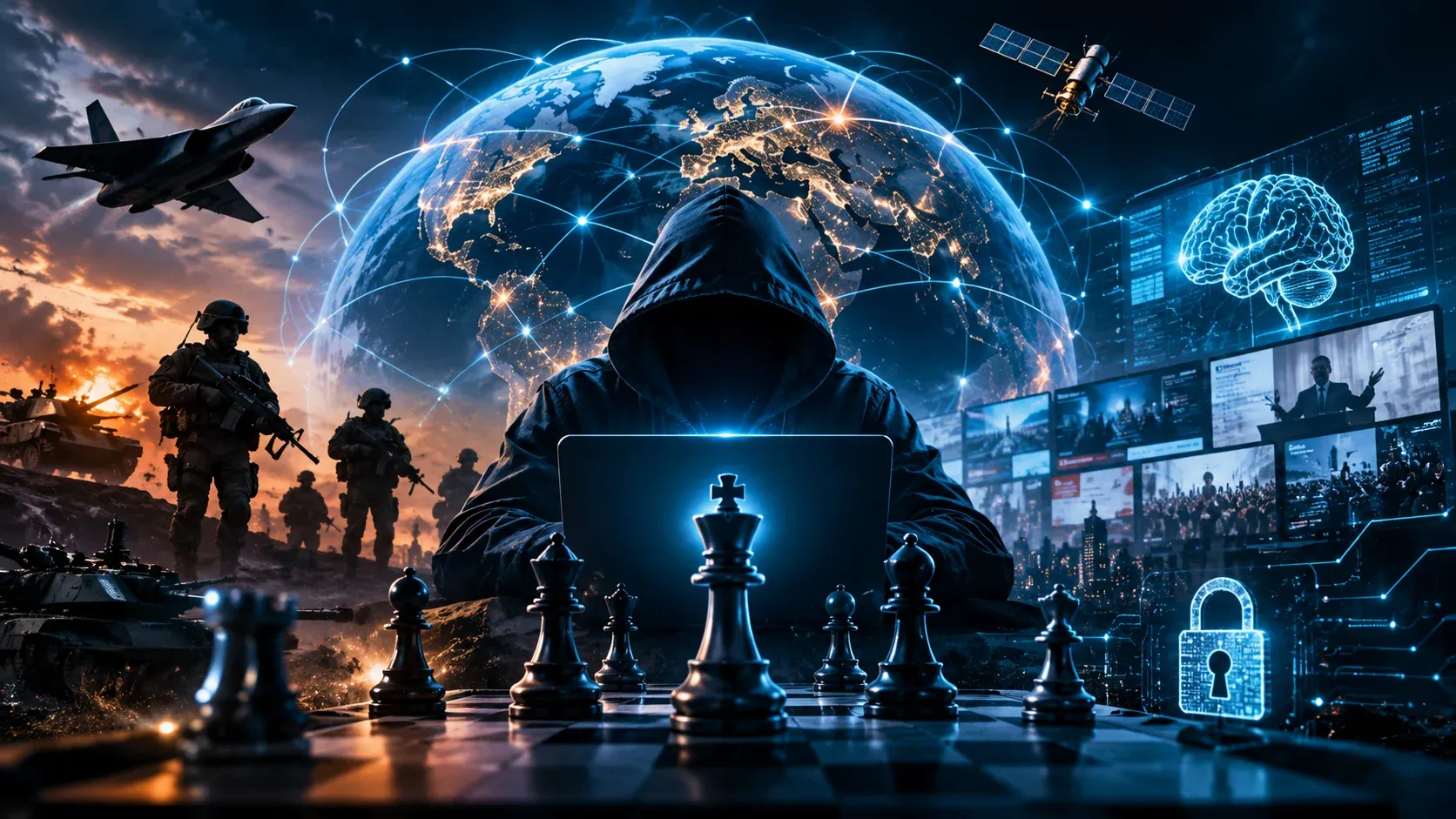
Picture a war and you probably see tanks, fighter jets and soldiers crossing a border. Fifth-generation warfare is the opposite picture: nobody crosses anything, nobody declares anything, and a society still gets pushed around.
Here is the uncomfortable part. A country can face economic pressure, cyberattacks and coordinated disinformation while its citizens go to work, send their kids to school and stream a show at night. No front line. No announcement.
Does that mean we are at war? Not exactly. But "peace" is harder to define than it used to be, and it's worth understanding why.
Are we really living in peacetime?
Conventional war hasn't gone anywhere. Russia's invasion of Ukraine is artillery, armor, missiles and attrition, the old-school version.
What changed is everything running alongside it. NATO's hybrid threats overview, updated in January 2026, says hostile actors mix military and non-military tools, covert and overt, from disinformation and cyberattacks to economic pressure. It also says the speed, scale and intensity of these activities have grown.
So the claim worth taking seriously is not "war is everywhere." It's that the line between peace and conflict has blurred.
What is fifth-generation warfare?
Fifth-generation warfare (5GW) is a framework for conflicts where influence, information, perception and technology do the heavy lifting. The goal isn't to destroy an army. It's to change how a society thinks, decides and reacts.
A quick map of the "generations":
- First: mass infantry in linear formations.
- Second: industrial firepower and attrition.
- Third: maneuver and speed.
- Fourth: insurgents, decentralized actors and a blurred line between combatants and civilians.
- Fifth: the fight moves into information environments and decision-making.
Two caveats. These generations are analytical labels, not agreed history. And 5GW has no single official doctrine: analysts, researchers and commentators use it differently. Treat it as a lens, not a law.
The hard part is detection. A trade deal isn't aggression. A political fight isn't proof of foreign meddling. A viral post isn't automatically an influence operation. The signal is coordination: separate, harmless-looking moves that add up to one campaign.
How does information become a weapon?
Propaganda isn't the same as lying. It's communication built to shape beliefs and behavior, and it can be made entirely of true facts, selectively framed. Disinformation is deliberately false or misleading content, and it works best when mixed with verifiable material, because the real parts lend credibility to the fake ones.
The effective version often invents nothing. It picks a real event, strips the context and amplifies one detail. A genuine scandal becomes proof that the whole system is rotten. An isolated security incident becomes "everything is failing."
NATO's approach to countering information threats describes these threats as intentional, harmful, manipulative and coordinated. It also warns that AI and deepfakes can amplify them and erode public trust in communications.
The result: people see the same facts and walk away with incompatible stories. And the more your attention is fragmented, the easier that gets. I wrote about the personal side of that in dopamine detox for men who want focus and purpose.
What is cognitive warfare?
Every military system, however advanced, depends on humans reading information and making decisions. Cognitive warfare targets that step.
The aim isn't always to make you believe one specific lie. Persistent confusion can be enough. People who trust no source can't reach shared conclusions. Citizens who assume every institution is corrupt stop participating. Decision-makers buried in contradictory intelligence hesitate when speed matters.
NATO's Chief Scientist has published a research report on cognitive warfare, treating it as a growing feature of modern conflict. In that framing, the target is not just an army or a government. It's a society's capacity to decide.
Pierre Bourdieu's idea of symbolic power, the ability to make one view of the world look natural, helps here. Cognitive operations compete for exactly that.
Why do social media and AI make this easier?
The barriers to reach collapsed. A small organization can now address an international audience without owning a TV network. Our ability to tell authentic from manipulated hasn't kept pace.
Ranking systems differ from platform to platform, but they generally reward engagement. Outrage and fear travel well. That doesn't mean algorithms push propaganda on purpose, or that every viral fight is manufactured. It means the attention economy creates incentives that organized campaigns can exploit.
There's also a trust shortcut. A post from a familiar account gets less scrutiny than an obvious ad, so telling grassroots from coordinated gets hard.
AI adds speed and scale. If you need the basics first, start with what generative AI actually is. It can analyze intelligence, translate, and produce synthetic media: a cloned voice, an image of an event that never happened. The nastier effect runs the other way, though. Once convincing fakes exist, real evidence can be waved off as fake, and shared facts get harder to establish.
Keep one limit in mind: sophisticated tech is not the same as effective strategy. AI content still needs credibility, distribution and a real understanding of the audience. And collecting data is the easy part. Interpreting it correctly is harder, because biased or incomplete datasets produce confident wrong answers.
NATO's January 2026 Alliance Digital Strategy points the same direction, stressing information and decision superiority, AI, human-machine collaboration and cyber resilience. [VERIFICAR: link]
Where do cyberattacks and economic pressure fit in?
Banks, power grids, hospitals, telecoms and military command all run on connected systems. A weak link in one organization can ripple across sectors.
Attribution makes it messier. Finding the technical origin of an attack doesn't tell you who authorized it, who paid for it or what it was for. Cyber operations can also support conventional ones, disrupting communications before anything physical moves.
Economics works the same way. Countries depend on others for chips, energy, minerals, pharmaceuticals and payment systems. Sanctions, export controls and investment limits turn those dependencies into leverage.
The goal often isn't to wreck an economy. It's to shrink the target's freedom to choose. A country with a first-class army but no domestic chips and a fragile grid has a problem, and tanks won't solve it.
How do institutions and social cohesion get eroded?
Max Weber argued that authority lasts when people believe it is legitimate. That is also the soft spot.
A society with distrust of institutions, corruption scandals, economic frustration and polarization is easier to manipulate. Hostile actors don't have to invent any of it. They amplify what's already there.
Division becomes strategic when it stops a population from seeing shared interests. When every disagreement is existential, compromise reads as betrayal and collective decisions stall. The erosion is also slow, with no single visible hit, and rebuilding legitimacy takes far longer than losing it.
One line matters here. Disagreement, opposition and harsh criticism are normal in a democracy. The problem starts when coordinated outside actors manipulate those tensions for strategic purposes.
How is it different from hybrid warfare?
They're related, not interchangeable. Hybrid warfare describes the coordinated use of conventional force, irregular forces, cyber operations, economic pressure, political interference and information activities. 5GW puts more weight on perception, cognition and decision-making.
In a real crisis they stack. Troop pressure near a border breeds fear, sanctions breed frustration, disinformation breeds confusion, and cyber incidents shake trust in institutions. The combined effect is bigger than the sum.
That's why NATO's official text on information threats calls for a holistic assessment that looks at information operations alongside physical actions. Militaries are adapting too: NATO's Warfighting Capstone Concept pairs multi-domain operations with cognitive superiority. [VERIFICAR: link]
[SEÇÃO PESSOAL: preencher. Perguntas-guia para o Marcus: (1) Teve algum momento em que você percebeu que uma narrativa viral moldava a opinião de um grupo que você conhece, e o que você notou? (2) Como você checa uma informação antes de compartilhar, na prática?]
How do you defend yourself without becoming paranoid?
Start here: not every argument is an influence operation. Not every economic problem is hostile interference, and not every unpopular decision is a coordinated strategy. A society that treats every disagreement as an attack damages the freedoms it's trying to protect.
There's a personal cost too. Constant alarming, contradictory information produces fatigue. Some people withdraw from public debate. Others retreat into ideological communities that offer simple answers to complicated events. Both make a society less resilient.
What helps, at the individual level:
- Verify before sharing. A dramatic headline or viral video is not evidence.
- Separate event from narrative. What happened and the story built around it are different things.
- Notice emotional triggers. Content designed to produce instant outrage or fear deserves a second look.
- Diversify your sources. Relying on one ideological community narrows your picture of reality.
- Protect your accounts. Strong authentication and updated software cut your exposure to cyber threats.
At the institutional level, resilience means reliable communication systems, transparent decision-making, cybersecurity and ways to spot coordinated interference. And defending society must never become an excuse to suppress criticism, opposition or free expression. The goal is resilience, not censorship.
Where is this heading?
Expect more AI, more autonomy and more cognitive operations. Agentic AI, systems that carry out sequences of tasks with some autonomy, is the piece to watch, with possible uses in analysis, monitoring and decision support. I covered the broader shift in the agentic shift toward autonomous AI.
A March 2026 document from NATO's Allied Command Transformation reportedly describes research into using agentic AI to achieve cognitive effects, including improving strategic communication and influencing adversary decision-making. [VERIFICAR: link]
That raises hard questions about accountability, human oversight and escalation. Technology doesn't remove the political nature of conflict. It changes the tools.
Conclusion: Peace isn't gone, it's just harder to define
Conventional wars aren't happening everywhere, and competition between states doesn't mean every country is fighting. But modern states operate in permanent strategic competition, where military power sits next to cyber operations, economic pressure, information manipulation and technological dependence.
The most dangerous operations may be the least visible. They don't level cities. They wear down credibility, deepen fragmentation and reduce a country's ability to act on its own.
So the question is no longer only who controls the territory. It's who controls the information, who shapes the decisions and who gets to define what counts as true. For a longer historical view, read 1926 vs. 2026: technology advances while peace fractures.
Next time a headline makes your blood boil within seconds, wait ten seconds before you share it. That small habit is the front line most of us actually hold. If this kind of analysis is useful to you, keep following the blog.
Frequently Asked Questions
What is fifth-generation warfare?
Fifth-generation warfare is an evolving framework for conflicts fought mainly through information, psychological influence, cyber capabilities and technology rather than direct military clashes. Its goal is to shape public perception, weaken institutions and change how an opponent makes decisions. It has no single official military definition, so analysts use the term in different ways.
What is the difference between fourth- and fifth-generation warfare?
Fourth-generation warfare is linked to decentralized conflict: insurgencies, terrorism and non-state actors blurring the line between combatants and civilians. Fifth-generation warfare shifts the focus to information environments, perception and decision-making. The two overlap, and neither is a universally standardized military classification, so treat both as analytical lenses rather than official categories.
How does artificial intelligence contribute to fifth-generation warfare?
AI speeds up intelligence analysis, translation and the production of synthetic media such as deepfakes, and it can multiply the scale of information campaigns. It is a tool, not a strategy: results still depend on credibility, distribution and understanding the target audience. Its biggest effect may be eroding trust, since real evidence can now be dismissed as fake.
Is social media a battlefield in modern warfare?
It can be. Governments and other actors may use platforms for propaganda, disinformation and influence operations, and engagement-driven ranking can reward emotional content that campaigns exploit. But ordinary political debate is not warfare. The signal to look for is coordination: many accounts or outlets pushing one narrative in a way that looks planned rather than organic.
How can individuals protect themselves against fifth-generation warfare?
Verify before you share, separate facts from interpretations, and be wary of content built to trigger instant outrage or fear. Read across different, credible sources instead of one ideological community. Add basic cybersecurity: strong authentication and updated software. The goal is resilience and independent judgment, not suspicion of everything.